Residents across the Village of Cottage Grove are feeling the same pressure: property taxes are climbing, costs are rising, and it is fair to ask whether the village is positioned to manage what comes next.
That question deserves a real answer, not a talking point. The answer starts with understanding how local government funding works in Wisconsin and why the current structure puts increasing pressure on communities like ours.
Over the past decade, state support to local governments has not kept pace with rising costs. While expenses for infrastructure, public safety, and basic services have increased due to inflation, revenue options available to villages have remained limited.
According to the University of Wisconsin Division of Extension, state income tax collections increased by more than 74 percent and sales tax collections increased by nearly 58 percent between 2003 and 2021, while shared revenue payments to local governments declined by approximately 12.9 percent during that same period.¹ This shift has created long term structural pressure on municipal budgets across Wisconsin.
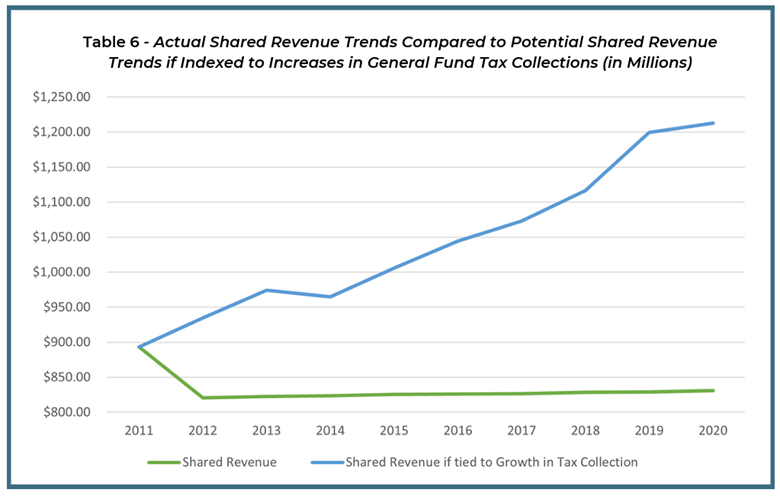
Figure 1. Shared revenue to local governments has remained largely flat over time compared to overall state tax growth. This widening gap has created long term financial pressure for municipalities across Wisconsin. Source: University of Wisconsin–Madison Division of Extension, Renewing a Sustainable and Equitable State and Local Government Funding Partnership (2023).¹
Research from the Wisconsin Policy Forum shows that rising operating costs, driven in part by inflation in recent years, have placed increasing financial pressure on municipalities across Wisconsin.³ In Wisconsin, property tax levy limits tie revenue growth to net new construction, limiting how quickly local revenues can grow even as costs increase.²
Reports from the Wisconsin Legislative Fiscal Bureau also show that shared revenue distributions have remained largely flat over time, contributing to long term structural pressure on local budgets.⁴
These statewide trends are not abstract for the Village of Cottage Grove. Under Wisconsin’s levy limit framework, our annual revenue growth is tied directly to net new construction.². When development slows, the ability to grow revenue slows as well, meaning existing taxpayers carry a larger share of rising costs. That is the structural reality behind every funding decision the village makes.
The Village of Cottage Grove is in a strong financial position today. We maintain an AA bond rating, use about half of our available debt capacity, and have followed a long term Financial Management Plan with municipal advisor Ehlers since 2009. Those are signs of careful planning over many years. But strong positioning does not happen by accident, and it does not maintain itself. It requires ongoing attention and deliberate decision making.
That is why these long term trends matter locally. They narrow the choices available to every Wisconsin municipality, including ours:
- Grow responsibly by adding development that strengthens the tax base
- Raise taxes through allowable increases or voter approved referendums
- Reduce or delay services, maintenance, or infrastructure investments
Each of these paths carries long term consequences, and the decisions made today will shape costs, taxes, and services for years to come. That is why this work requires more than good intentions. It requires understanding capital investment cycles, debt management, infrastructure capacity planning, and how each development decision affects the village’s long term fiscal position.
The Village of Cottage Grove already has strong financial tools in place. My focus as a Trustee will be making sure we use them: maintaining disciplined planning, investing strategically, and making decisions grounded in the data and systems that have kept this village financially sound.
Sources
¹ University of Wisconsin–Madison Division of Extension
Renewing a Sustainable and Equitable State and Local Government Funding Partnership (2023)
https://localgovernment.extension.wisc.edu/files/2023/02/Renewing-a-Sustainable-Equitable-State-and-Local-Government-Funding-Partnership-Version-1.24.23-v-2.pdf
² League of Wisconsin Municipalities / Ehlers
Budgeting and Levy Limits (2019)
https://www.lwm-info.org/DocumentCenter/View/3013/Local-Government-Levy-Limits_Ehlers-Material_2019-5-13
³ Wisconsin Policy Forum
MuniTool Municipal Financial Condition Media Release (2025)
https://wispolicyforum.org/wp-content/uploads/2025/08/MuniTool2025_Media-Release.pdf
⁴ Wisconsin Legislative Fiscal Bureau
Shared Revenue Program — County and Municipal Aid and Utility Aid (2023)
https://docs.legis.wisconsin.gov/misc/lfb/informational_papers/january_2023/0022_shared_revenue_program_county_and_municipal_aid_and_utility_aid_informational_paper_22.pdf
 JP for Cottage Grove