
When residents receive their property tax bill each year, it is easy to assume the village is responsible for most of it. In reality, the largest share supports our local schools.
In the most recent property tax bill, the Monona Grove School District accounted for 53.3% of the total tax bill, meaning more than half of every property tax dollar paid by residents supports the district¹. Even more striking, 77% of last year’s tax increase came from the school district portion.
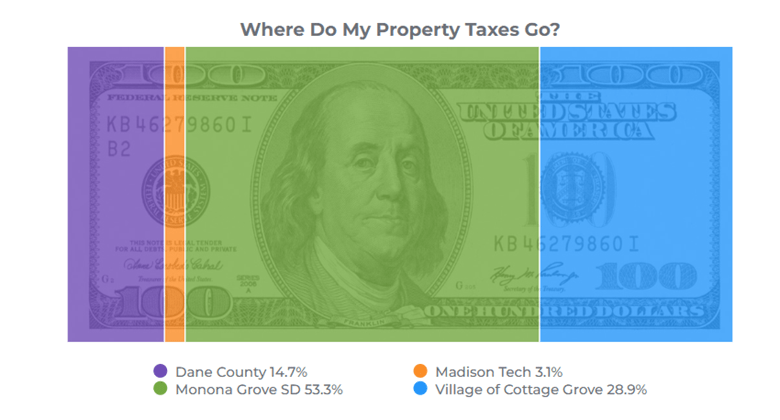
This means the financial stability of the school district is not just an education issue. It is also a tax issue for every homeowner.
This is not a criticism of the district. It reflects how Wisconsin funds public education. However, it highlights an important reality: the financial health of our schools plays a major role in the overall tax burden for residents.
While school districts operate under their own state funding system, local planning decisions still matter. Housing and development policies influence who moves into a community, which affects school enrollment, the local tax base, and ultimately the financial outlook for our schools.
The Structure of School Funding in Wisconsin
Wisconsin school districts operate under a state revenue limit system that tightly controls how much funding districts can receive each year.
Most district revenue is determined through state formulas tied to student enrollment. According to the Monona Grove School District’s financial overview, more than 80% of district revenue is tied to state-controlled funding mechanisms.²
**Note: Residents who would like to learn more about the district’s financial outlook can watch the beginning of the March 10, 2026 school board meeting and review the Monona Grove School District Financial Overview presentation discussed during that meeting.
Because of this system, local school boards have limited ability to increase revenue without voter approval through referendums.
At the same time, state funding has not kept pace with inflation. The district estimates that if revenue limits had been indexed to inflation, Monona Grove would receive roughly $4,210 more per student today, or about $13.8 million more annually.² As costs rise faster than revenue, more districts across Wisconsin are turning to referendums to stabilize their budgets.
Because enrollment is a key component of Wisconsin’s school funding formula, demographic trends and community growth patterns can also play an important role in shaping a district’s long-term financial outlook.
Enrollment, Housing, and School Finances
Because school funding is tied in part to enrollment, demographic trends matter.
When enrollment grows steadily, districts can spread fixed costs across more students. When enrollment declines or stagnates, districts must operate the same facilities and services with fewer resources.
The MGSD financial forecast shows increasing budget pressure later in the decade if current trends continue.²
Housing availability plays an important role in shaping enrollment trends. Dane County is the fastest growing county in Wisconsin and has added tens of thousands of residents and households over the past decade. At the same time, housing construction has not kept pace with population growth, creating a regional housing shortage.5
When housing supply falls behind population growth, fewer young families are able to move into communities where they want to live. Communities that provide housing opportunities for families are more likely to maintain stable school enrollment over time.
Research from the Joint Center for Housing Studies of Harvard University shows that housing supply constraints can limit where families with children are able to live.4
Over time, these housing patterns influence the demographic makeup of a community and the long-term financial outlook for local schools.
Planning for the Future
The Monona Grove School District’s financial overview highlights long-term fiscal challenges, including structural budget pressures and future facility needs.²
Addressing these challenges will require collaboration among residents, the school district, and local governments.
Community planning decisions, including housing development, economic growth, and infrastructure investments, help shape the environment in which our schools operate. Thoughtful growth can help support stable enrollment, strengthen the local tax base, and sustain the services that make our community strong.
Cottage Grove has long been a place where families choose to live because of strong schools, safe neighborhoods, and a strong sense of community. That is why I have been advocating for a healthy housing market with a range of housing options that are attainable for residents. When communities create opportunities for families to move in, it helps support stable school enrollment and strengthens the long-term outlook for both our schools and our village.
References
- Village of Cottage Grove Financial Transparency Center (ClearGov). Property tax distribution data.
- Monona Grove School District. Financial Overview, Finance & Operations Committee Meeting, February 26, 2026.
- Wisconsin Policy Forum. School Funding in Wisconsin: Trends and Comparisons.
- Brookings Institution. Demographic Change and the Future of School Enrollment in the United States.
- Joint Center for Housing Studies of Harvard University. The State of the Nation’s Housing 2023.
- Dane County Regional Housing Strategy. Strategic Action Plan 2024–2028.
 JP for Cottage Grove